
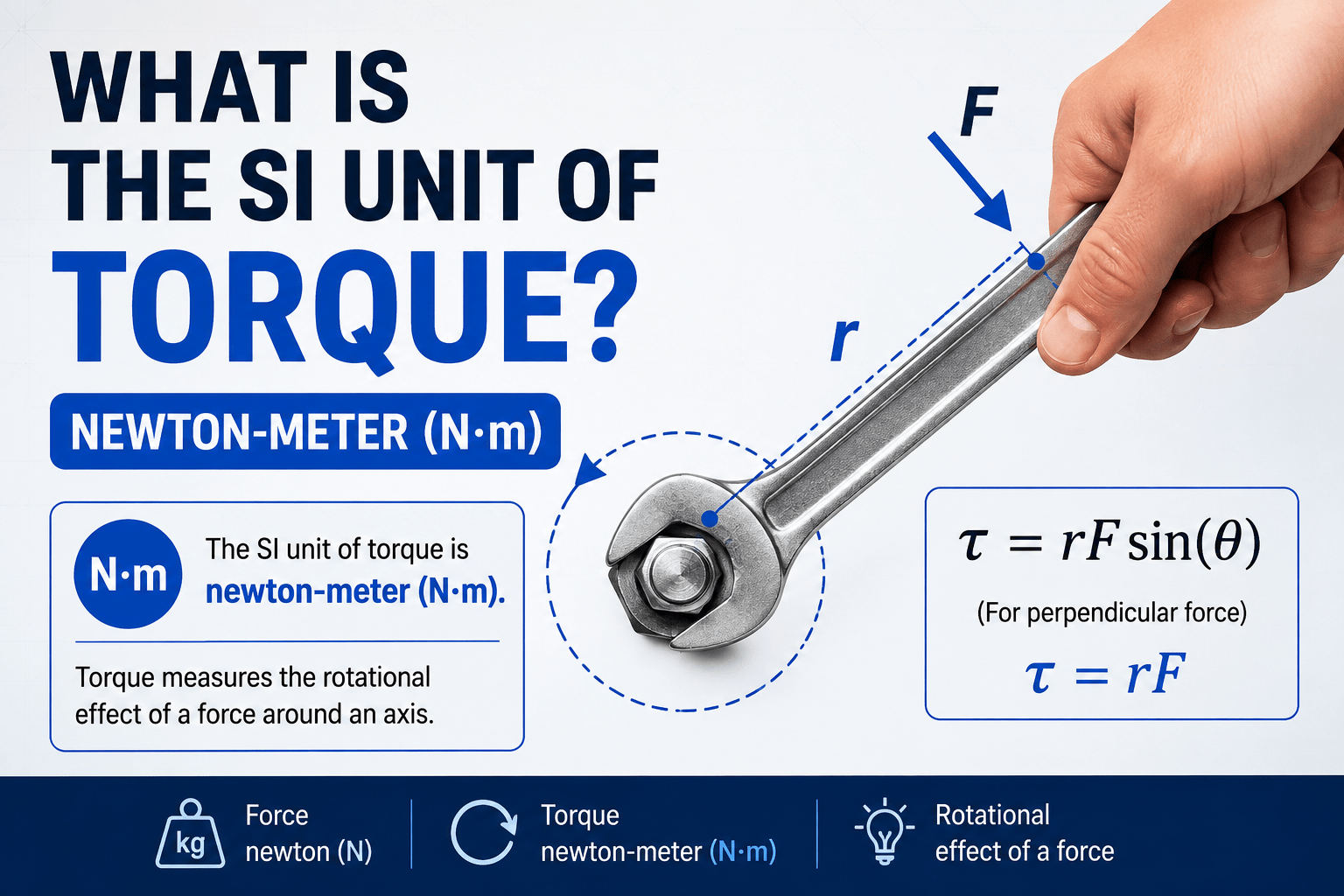
One of The SI units in physics / SI unit is the SI unit of torque is the newton-meter (N·m). Torque is a physical quantity that measures the rotational effect of a force around a point or axis.
In simple terms, torque tells us how strongly a force can make an object rotate. For example, when you use a wrench to turn a bolt, the force you apply to the handle produces torque around the bolt.
What Is Torque?
Torque is the rotational equivalent of force. While force can cause an object to accelerate in a straight line, torque can cause an object to rotate.
Torque depends on three main factors:
- The magnitude of the force
- The distance from the axis of rotation
- The angle at which the force is applied
The general equation for torque is:
τ = rF sin(θ)
where:
- τ = torque
- r = distance from the axis of rotation
- F = applied force
- θ = angle between the force and the lever arm
When the force is applied perpendicular to the lever arm, the equation becomes:
τ = rF
This is the simplest case for calculating torque.
What Is the SI Unit of Torque?
The SI unit of torque is the newton-meter (N·m).
The unit comes directly from the torque equation. Since force is measured in newtons (N) and distance is measured in meters (m), torque is expressed as:
newton × meter = N·m
Therefore:
1 N·m = 1 newton-meter
A torque of 1 N·m occurs when a force of 1 newton is applied at a perpendicular distance of 1 meter from the axis of rotation.
Why Is Torque Measured in Newton-Meters?
The newton-meter describes both the force being applied and its distance from the axis of rotation.
For example, imagine a wrench that is 0.5 meters long. If you apply a force of 10 N perpendicular to the wrench, the torque is:
τ = rF
τ = (0.5 m)(10 N)
τ = 5 N·m
Therefore, the applied force produces 5 N·m of torque.
This demonstrates why increasing the distance from the axis can increase torque even when the applied force remains the same.
Newton-Meter vs. Newton
A newton (N) and a newton-meter (N·m) measure different physical quantities.
A newton measures force, while a newton-meter measures torque.
For example:
- Force → newton (N)
- Torque → newton-meter (N·m)
- Energy → joule (J)
Although a joule can also be expressed dimensionally as N·m, torque and energy are different physical quantities because they describe different physical concepts.
Is N·m the Same as Joules?
The units N·m and joule (J) are dimensionally equivalent, but they should not normally be used interchangeably.
A joule measures energy or work, whereas a newton-meter used for torque measures a rotational effect.
For example:
Energy: 10 J
Torque: 10 N·m
The numerical values may be the same, but the physical meanings are different.
This distinction is important when studying mechanics and rotational motion.
How Do You Calculate Torque?
To calculate torque when the force is perpendicular to the lever arm, use:
τ = rF
Suppose you push a door with a force of 20 N at a point 0.8 m from its hinges.
The torque is:
τ = (0.8 m)(20 N)
τ = 16 N·m
The torque about the hinges is therefore 16 N·m.
If the force is not perpendicular to the lever arm, the angle must be included:
τ = rF sin(θ)
For example, if the force is 20 N, the distance is 0.8 m, and the angle is 30°:
τ = (0.8)(20)sin(30°)
Since sin(30°) = 0.5:
τ = 8 N·m
What Is the SI Unit of Torque in Dimensional Form?
The newton can be expressed using SI base units as:
1 N = 1 kg·m/s²
Therefore:
1 N·m = 1 kg·m²/s²
So the SI base-unit expression for torque is:
kg·m²/s²
This is useful when working with dimensional analysis and more advanced physics problems.
Torque in Everyday Life
Torque is important in many everyday situations and mechanical systems.
Some examples include:
- Turning a wrench
- Opening a door
- Pedaling a bicycle
- Turning a screwdriver
- Rotating a wheel
- Operating an engine
- Tightening a bolt
- Rotating machinery
In each case, torque describes the rotational effect produced by a force.
What Happens When the Lever Arm Gets Longer?
For a perpendicular force, torque is directly proportional to the distance from the axis:
τ = rF
If the force stays constant and the lever arm becomes longer, the torque increases.
For example, applying 10 N of force at:
- 0.2 m → 2 N·m
- 0.5 m → 5 N·m
- 1.0 m → 10 N·m
This is why a longer wrench can make it easier to turn a tight bolt.
Frequently Asked Questions
What is the SI unit of torque?
The SI unit of torque is the newton-meter (N·m).
Is torque measured in N or N·m?
Torque is measured in newton-meters (N·m), not simply newtons. A newton is the SI unit of force.
Is torque the same as energy?
No. Although N·m and joules have equivalent SI base units, torque and energy represent different physical quantities.
What is the formula for torque?
The general formula is τ = rF sin(θ), where r is the distance from the axis, F is the force, and θ is the angle between them.
What is 1 N·m of torque?
One newton-meter is the torque produced by a 1 N force acting perpendicular to a point located 1 meter from the axis of rotation.
Conclusion
The SI unit of torque is the newton-meter (N·m). Torque measures the rotational effect of a force and depends on the applied force, the distance from the axis of rotation, and the angle of the force.
The basic torque equation is:
τ = rF sin(θ)
Understanding the newton-meter is essential for studying rotational motion, mechanics, engines, machines, and many everyday mechanical systems.