
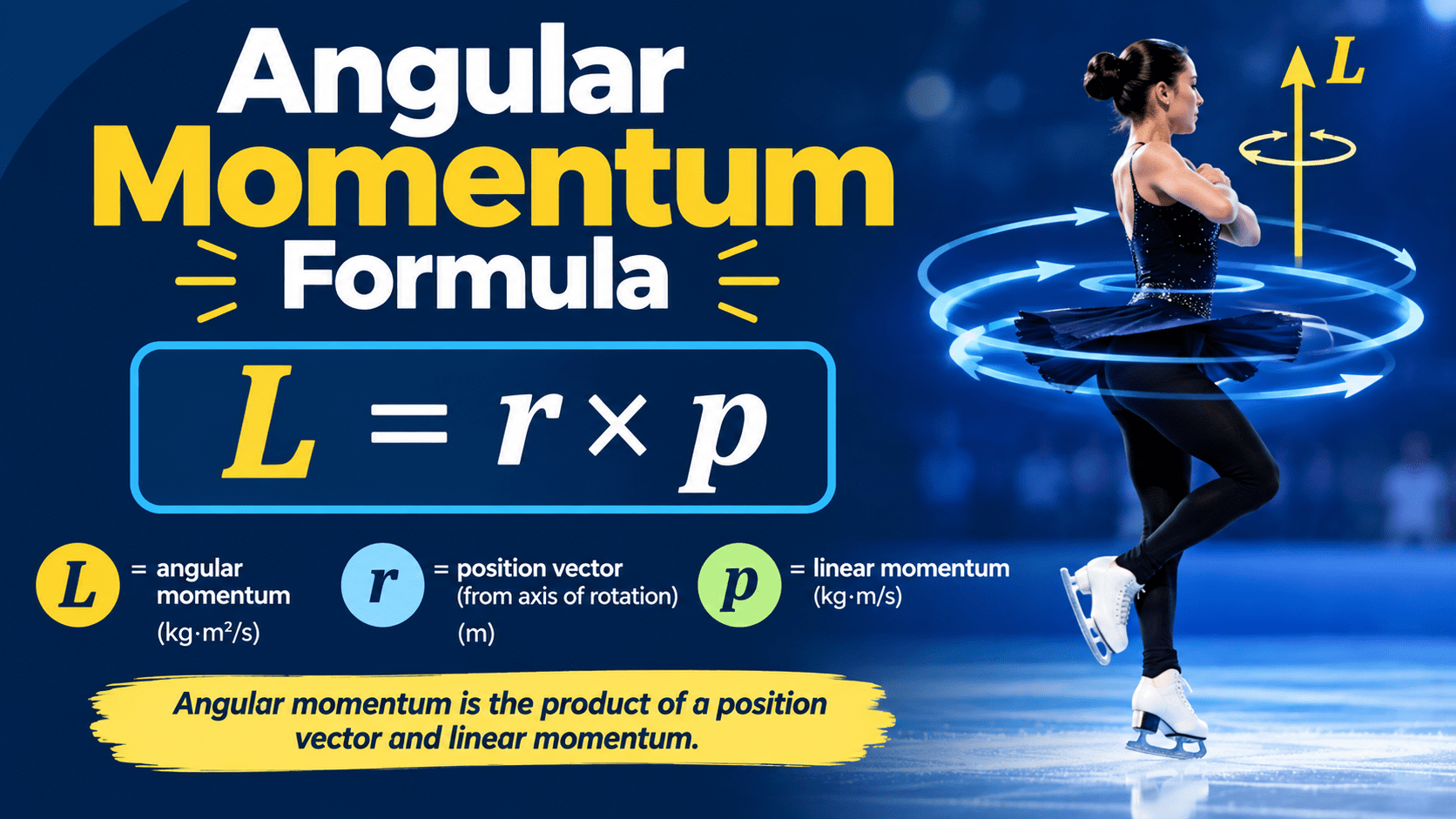
Learn the angular momentum formula, (L = r \times p), including its definition, variables, units, direction, conservation, and practical examples.
What Is Angular Momentum?
Angular momentum is a fundamental concept in physics that describes the rotational motion of an object around a point or axis. Just as linear momentum describes how difficult it is to stop an object moving in a straight line, angular momentum describes how difficult it is to stop or change an object’s rotational motion.
The angular momentum formula for a particle is:
[
\boxed{L = r \times p}
]
where:
- L = angular momentum
- r = position vector from the axis or reference point to the object
- p = linear momentum
- × = vector cross product
Since linear momentum is:
[
p = mv
]
the angular momentum can also be expressed as:
[
\boxed{L = r \times mv}
]
For a simple case where the position vector and velocity are perpendicular:
[
\boxed{L = mvr}
]
Angular Momentum Formula Explained
The equation (L = r \times p) shows that angular momentum depends on both the object’s distance from the axis of rotation and its linear momentum.
For the magnitude of angular momentum:
[
L = rp\sin\theta
]
Substituting (p = mv):
[
\boxed{L = rmv\sin\theta}
]
Here, (\theta) is the angle between the position vector (r) and the momentum vector (p).
When the object moves perpendicular to the radius, (\theta = 90^\circ), and since (\sin 90^\circ = 1):
[
L = rmv
]
This is why the simplified formula (L = mvr) is commonly used for circular motion.
What Do the Variables Mean?
L — Angular Momentum
Angular momentum measures the rotational motion of an object relative to a chosen point or axis.
Its SI unit is:
[
\boxed{\text{kg}\cdot\text{m}^2/\text{s}}
]
Angular momentum is a vector, meaning it has both magnitude and direction.
r — Position Vector
The position vector (r) represents the distance and direction from the reference point or axis to the object.
It is measured in meters (m).
A greater distance from the axis generally means greater angular momentum, assuming the object’s momentum remains the same.
p — Linear Momentum
Linear momentum is given by:
[
p = mv
]
where:
- (m) = mass in kilograms
- (v) = velocity in meters per second
The SI unit of linear momentum is:
[
\text{kg}\cdot\text{m/s}
]
Direction of Angular Momentum
Because angular momentum is a vector, its direction is important.
The direction of (L) is determined using the right-hand rule. Point the fingers of your right hand in the direction of the object’s rotational motion and curl them toward the direction of rotation. Your thumb points in the direction of the angular momentum vector.
For counterclockwise rotation, the angular momentum vector generally points out of the page. For clockwise rotation, it points into the page.
Angular Momentum in Circular Motion
Angular momentum is particularly useful when studying objects moving in circles.
Suppose a ball with mass (m) moves around an axis at a radius (r) with speed (v). If the velocity is perpendicular to the radius, its angular momentum is:
[
\boxed{L = mvr}
]
Example
A 2 kg object moves at a speed of 5 m/s around an axis at a radius of 3 m.
Using:
[
L = mvr
]
we get:
[
L = (2)(5)(3)
]
[
\boxed{L = 30\text{ kg}\cdot\text{m}^2/\text{s}}
]
Therefore, the object’s angular momentum is 30 kg·m²/s.
Angular Momentum of a Rotating Rigid Body
For a rigid object rotating around a fixed axis, angular momentum is commonly written as:
[
\boxed{L = I\omega}
]
where:
- L = angular momentum
- I = moment of inertia
- ω = angular velocity
The moment of inertia depends on how the mass of an object is distributed relative to its axis of rotation.
This formula is the rotational equivalent of the linear momentum relationship:
[
p = mv
]
In a rotating system, the moment of inertia plays a role similar to mass, while angular velocity plays a role similar to linear velocity.
Conservation of Angular Momentum
One of the most important ideas associated with angular momentum is the law of conservation of angular momentum.
When no external torque acts on a system, its total angular momentum remains constant:
[
\boxed{L_{\text{initial}} = L_{\text{final}}}
]
This principle explains many phenomena in everyday life and nature.
For example, when a figure skater pulls their arms closer to their body while spinning, their moment of inertia decreases. To conserve angular momentum, their angular velocity increases, causing them to spin faster.
Similarly, planets and other astronomical objects exhibit rotational behavior that can be understood using conservation of angular momentum.
Angular Momentum and Torque
Angular momentum is closely related to torque.
Torque describes the tendency of a force to produce rotational motion, while angular momentum describes the rotational motion itself.
The relationship is:
[
\boxed{\tau = \frac{dL}{dt}}
]
where (\tau) is torque.
If the net external torque on a system is zero:
[
\tau_{\text{net}} = 0
]
then:
[
\frac{dL}{dt}=0
]
which means angular momentum remains constant.
Linear Momentum vs. Angular Momentum
Although linear and angular momentum are related, they describe different types of motion.
| Linear Momentum | Angular Momentum |
|---|---|
| (p = mv) | (L = r \times p) |
| Describes translational motion | Describes rotational motion |
| Depends on mass and velocity | Depends on position and linear momentum |
| Unit: kg·m/s | Unit: kg·m²/s |
| Associated with straight-line motion | Associated with rotation |
Understanding this distinction makes it easier to determine which momentum equation should be used in a physics problem.
Why Is Angular Momentum Important?
Angular momentum helps explain how rotating systems behave. It is used in many areas of physics and engineering, including:
- Rotating machinery
- Figure skating
- Planetary motion
- Satellites and spacecraft
- Gyroscopes
- Wheels and gears
- Rotational dynamics
- Astrophysics
The concept is especially important because angular momentum is conserved in isolated systems.
Key Takeaway
The main angular momentum formula is:
[
\boxed{L = r \times p}
]
For the magnitude:
[
\boxed{L = rp\sin\theta}
]
And because (p = mv):
[
\boxed{L = rmv\sin\theta}
]
For perpendicular motion:
[
\boxed{L = mvr}
]
For a rigid body rotating around a fixed axis:
[
\boxed{L = I\omega}
]
In simple terms, angular momentum describes how much rotational motion an object has relative to a point or axis. It depends on the object’s mass, velocity, position relative to the axis, and the direction of its motion.