
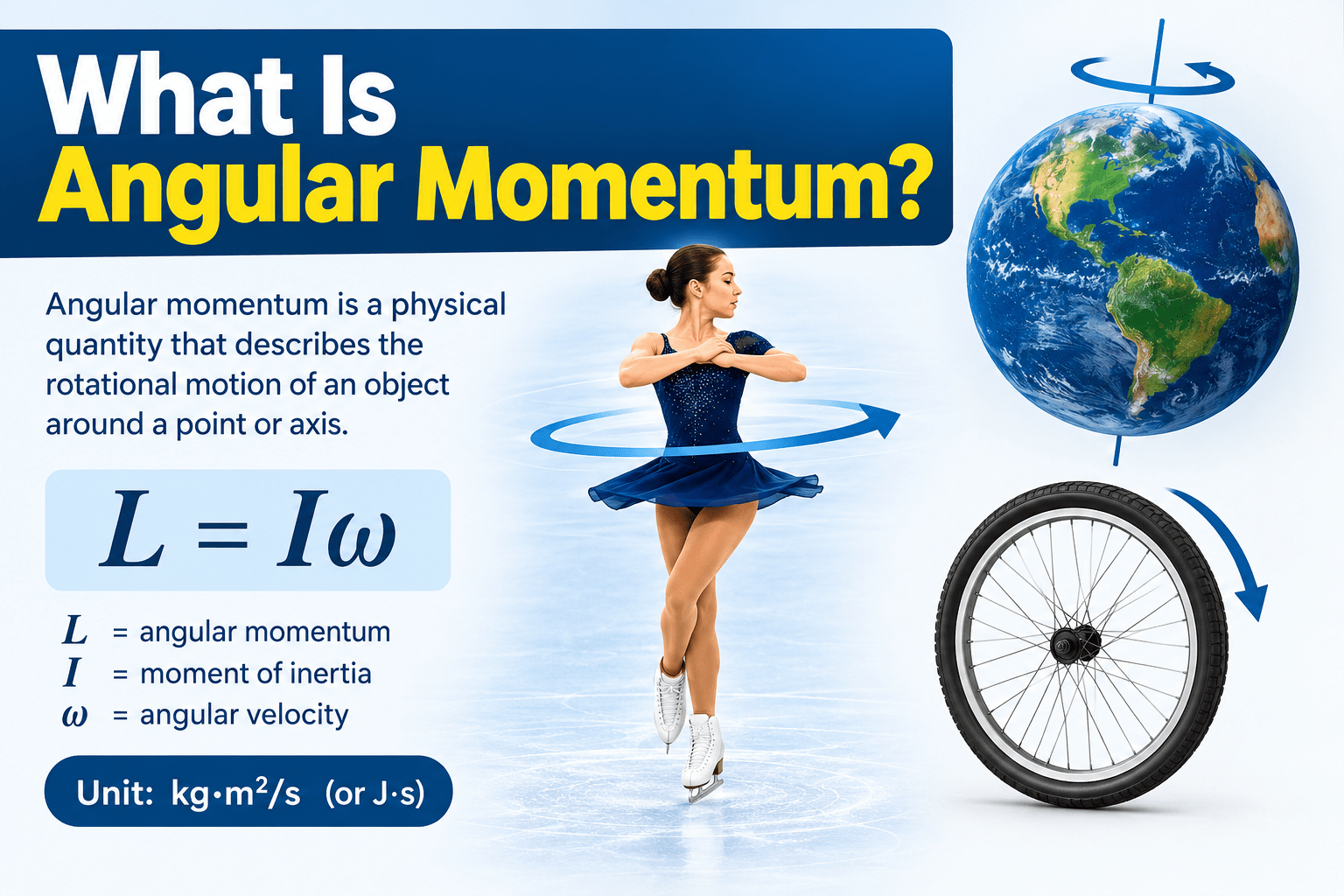
Angular momentum is a physical quantity that describes the rotational motion of an object around a point or axis. It is the rotational equivalent of linear momentum and depends on the object’s mass, its distance from the axis of rotation, and its angular velocity.
In simple terms, angular momentum tells us how much rotational motion an object has.
The symbol for angular momentum is (L), and its SI unit is kilogram meter squared per second (kg·m²/s).
Angular Momentum Definition
Angular momentum is the measure of the rotational motion of an object relative to a reference point or axis. Is a linear momentum.
For an object rotating around a fixed axis, angular momentum can be calculated using:
[
L = I\omega
]
where:
- (L) = angular momentum
- (I) = moment of inertia
- (\omega) = angular velocity
The moment of inertia depends on how the mass of the object is distributed relative to the axis of rotation.
For a point object, angular momentum can also be expressed as:
[
L = r p \sin\theta
]
where:
- (r) = distance from the object to the axis
- (p) = linear momentum
- (\theta) = angle between the position vector and linear momentum
Since linear momentum is:
[
p = mv
]
we can write:
[
L = rmv\sin\theta
]
When the velocity is perpendicular to the radius ((\theta=90^\circ)), the equation becomes:
[
L = rmv
]
What Is the Formula for Angular Momentum?
The most common formula for the angular momentum of a rigid body rotating around a fixed axis is:
[
\boxed{L=I\omega}
]
This equation shows that angular momentum increases when either the moment of inertia or angular velocity increases.
For example, if a rotating object has a moment of inertia of (4\text{ kg·m}^2) and an angular velocity of (5\text{ rad/s}):
[
L=(4)(5)
]
[
L=20\text{ kg·m}^2/\text{s}
]
Therefore, the angular momentum is 20 kg·m²/s.
What Is the SI Unit of Angular Momentum?
The SI unit of angular momentum is:
[
\boxed{\text{kg·m}^2/\text{s}}
]
It can also be written as:
[
\text{J·s}
]
because a joule-second has the same dimensions as kilogram meter squared per second.
Angular momentum is a vector quantity, which means it has both magnitude and direction.
The direction of angular momentum is determined using the right-hand rule.
How Is Angular Momentum Related to Linear Momentum?
Angular momentum and linear momentum describe different types of motion.
Linear momentum describes the motion of an object moving from one place to another:
[
p=mv
]
Angular momentum describes rotational motion:
[
L=I\omega
]
For example, a car moving along a straight road has linear momentum. A spinning wheel has angular momentum.
The two quantities are related because rotational motion can be described in terms of the linear momentum of particles moving around an axis.
What Is Conservation of Angular Momentum?
The law of conservation of angular momentum states that the total angular momentum of a system remains constant when no external torque acts on the system.
In mathematical form:
[
L_i=L_f
]
where:
- (L_i) = initial angular momentum
- (L_f) = final angular momentum
This principle explains many rotational phenomena in physics.
Example: A Figure Skater
A figure skater provides a simple example of conservation of angular momentum.
When the skater spins with their arms extended, their mass is distributed farther from the axis of rotation. This gives them a larger moment of inertia.
When the skater pulls their arms toward their body, the moment of inertia decreases.
If external torque is negligible, angular momentum remains constant:
[
I_i\omega_i=I_f\omega_f
]
Therefore, when the moment of inertia decreases, the angular velocity increases.
That is why the skater spins faster when bringing their arms closer to their body.
Examples of Angular Momentum
Angular momentum occurs in many everyday situations and natural phenomena.
1. A Spinning Bicycle Wheel
A bicycle wheel rotating around its axle has angular momentum. Increasing its rotational speed increases its angular momentum.
2. A Spinning Earth
Earth rotates around its axis and therefore has angular momentum. Its rotation is an important example of angular momentum on a planetary scale.
3. A Figure Skater
A spinning skater can change their rotational speed by changing the distribution of their mass around their axis.
4. A Rotating Fan
The blades of a fan rotate around a central axis. Because the blades have mass and angular velocity, the rotating system has angular momentum.
5. A Planet Orbiting the Sun
A planet moving around the Sun has orbital angular momentum. This angular momentum is related to the planet’s position and linear momentum.
Angular Momentum vs. Torque
Angular momentum and torque are closely related, but they are not the same physical quantity.
Torque describes the tendency of a force to produce rotational acceleration, while angular momentum describes the rotational motion of an object.
Their relationship is:
[
\boxed{\tau=\frac{dL}{dt}}
]
where:
- (\tau) = torque
- (L) = angular momentum
- (t) = time
If the net external torque is zero:
[
\tau=0
]
then:
[
\frac{dL}{dt}=0
]
which means angular momentum remains constant.
Angular Momentum and Moment of Inertia
The moment of inertia (I) measures how difficult it is to change an object’s rotational motion.
It depends not only on the object’s mass but also on how far that mass is distributed from the axis of rotation.
For a point mass:
[
I=mr^2
]
Substituting this into (L=I\omega) gives:
[
L=mr^2\omega
]
This shows why the distance from the axis is important when calculating angular momentum.
Worked Example of Angular Momentum
Suppose a (2\text{ kg}) object is located (0.5\text{ m}) from an axis and moves in a circular path with a tangential velocity of (4\text{ m/s}).
Because the velocity is perpendicular to the radius, we use:
[
L=rmv
]
Substituting the values:
[
L=(0.5)(2)(4)
]
[
L=4\text{ kg·m}^2/\text{s}
]
Therefore, the object’s angular momentum is:
[
\boxed{4\text{ kg·m}^2/\text{s}}
]
Why Is Angular Momentum Important?
Angular momentum is important because it allows physicists to analyze and predict rotational motion.
The concept is used in:
- classical mechanics
- planetary motion
- astronomy
- engineering
- robotics
- rotating machines
- sports
- spacecraft dynamics
The conservation of angular momentum is especially useful because it explains how rotating systems behave when external torques are small or absent.
Frequently Asked Questions About Angular Momentum
What is angular momentum in simple terms?
Angular momentum is a measure of how much rotational motion an object has around an axis or point.
What is the formula for angular momentum?
For a rigid object rotating around a fixed axis, the formula is:
[
L=I\omega
]
For a point object, it can be written as:
[
L=rp\sin\theta
]
What is the unit of angular momentum?
The SI unit of angular momentum is kg·m²/s. It can also be expressed as J·s.
Is angular momentum a vector?
Yes. Angular momentum is a vector quantity, so it has both magnitude and direction.
What happens to angular momentum when there is no external torque?
When the net external torque is zero, angular momentum is conserved. The total angular momentum of the system remains constant.
What is an example of conservation of angular momentum?
A figure skater spinning with their arms extended and then pulling their arms inward is a common example. As the moment of inertia decreases, the skater’s angular velocity increases so that angular momentum remains constant.
Summary
Angular momentum is a measure of rotational motion. For an object rotating around a fixed axis, it is calculated using:
[
\boxed{L=I\omega}
]
For a point mass, angular momentum can be calculated using:
[
\boxed{L=rmv\sin\theta}
]
Angular momentum is measured in kg·m²/s and is conserved when no net external torque acts on a system.
Understanding angular momentum is essential for studying rotating objects, spinning wheels, planets, satellites, and many other physical systems.